
Category Archives: Advocacy Updates

Last Chance to Object to Purdue Bankruptcy

There’s still time to let your AG and government officials know that you want them to object to the Purdue Bankruptcy plan.

A group called “Unleash the Mothers,” led by Susan Ousterman from PA, is spearheading last-minute efforts to block the Purdue bankruptcy. They’re at unleashthemothers@gmail.com if you need more information.

They sent an email to us stating:

We want to bring some important issues to your attention ahead of the Purdue Pharma bankruptcy confirmation hearing, which begins Wednesday, November 12th. What they are doing is worse than anyone expected. Of course, it shields billionaires, but also includes coercive third-party releasespits surviving victims against one another, and forces claimants to vote/consent before knowing if their claim is viable. They are aggressively rejecting personal injury claims, and the plan diverts $750 million to the Sacklers’ defense while only a fraction reaches victims’ families. 

And just today, they filed an amended version of the plan that includes significant changes, and a provision that doesn’t require a new vote by claimants. So, essentially, this is a different plan than the one voted on! Some of those changes are:

  • Expanded Administrative Discretion and Claim Filtering
  • Broadened Sackler Immunity and Indemnity Protections
  • Weakening of Public Benefit Company Obligations
  • Violation of Disclosure and Consent Principles

We’re asking EVERY claimant, advocate, and ally to withdraw support and contact anyone you have local connections with, especially your state Attorney General, Governor, or county officials, and urge them to:

*Withdraw support for the Purdue bankruptcy plan and finally stand with victims.*

You can personalize the attached letter or write your own, then email it to your local officials ASAP. You may also include the attached fact sheet. If you prefer calling, a phone script is provided as well. I know it’s late in the game, but even sharing this message can make a difference.

We can’t bring back our loved ones, but we can honor them by using our voices for change. We know the harms of drug policy run much deeper, and this moment isn’t just about Purdue; it’s about exposing how our legal system continues to protect power at the expense of truth.

Unleash the Mothers

Here’s the sample letter they’ve recommended sending and/or a script for a phone call.

Email Template to Attorneys General, Governors, or County Officials (feel free to edit to use examples of issues in your state, and personalize before copying into an email)

Subject: Urgent Request: Withdraw Support for the Purdue Pharma Bankruptcy Plan

My name is ____________, and I am directly impacted by the opioid crisis. [Optional: share your story] I am writing to bring your attention to critical flaws in the Purdue Pharma bankruptcy settlement plan. As it stands, this plan is poised to deliver a second injustice to opioid victims and the public. We also don’t need more “abatement funds” that sit unspent. The argument that funds are needed to abate the crisis no longer holds water. Pennsylvania is set to receive $200 million from this settlement, and currently has $260 million sitting unspent, collecting interest. They are asking plaintiffs for extensions to spend this money while overdose deaths remain extraordinarily high and bereaved families suffer.

Below are the major issues undermining the fairness and integrity of the Purdue settlement:

  • Secret Rewrite After the Vote: The 16th Amended Plan, filed on 11/7/25, after the voting and objection deadlines had passed, made material changes without re-solicitation—altering the very deal victims believed they were voting on. These changes include: (1) further restricting eligibility for Neonatal Abstinence Syndrome (NAS) claims and potentially reclassifying them outside personal injury compensation; (2) revising definitions that narrow the scope of what counts as a qualifying opioid-related injury; (3) tightening claim documentation requirements in ways that will disqualify more victims after the fact; and (4) modifying language that expands the Sacklers’ protection by adjusting release scope and enforcement provisions. These late-stage edits exploit procedural loopholes to retroactively limit payouts and shield non-debtors—all without claimant input or judicial scrutiny based on the actual plan now in effect. This is legal sleight of hand, not justice.
  • Coerced Legal Immunity for the Sacklers: A “yes” vote on the plan didn’t just approve the deal, but it also forced victims to release the Sackler family from all civil liability. Many claimants did not realize that by voting in favor, they were waiving their right to sue the Sacklers. Those who refused to sign away these rights were designated as having “Partially Channeled Claims” and made ineligible for payout. In short, the Sacklers’ legal protection was effectively bought using the desperation of victims, raising serious due process concerns (and stretching bankruptcy law beyond its limits in §524(e)).
  • Deceptive Approval Rate and Flawed Voting Process: The plan’s backers claim it had “over 95–99% approval” from claimants. This is deeply misleading. Of the 640,000+ who filed personal injury claims, fewer than 60,000 had their votes counted. Many never received ballots or were disqualified after voting, yet their votes were still included in the tally. Worse, ballots were sent before most claims were vetted, meaning people voted without knowing if they were eligible or how much they’d receive. This violates basic principles of informed consent and undermines the legitimacy of the vote under 11 U.S.C. §1125(b).
  • Victims Get Pennies While Lawyers Get Billions: The plan’s balance of payouts is fundamentally unjust. Total professional fees and expenses in this bankruptcy exceed $1 billion, including a special reserve to fund the Sacklers’ own defense costs. Meanwhile, the pool earmarked for individual victims is under $800 million, amounting to a few thousand dollars per victim at best. That’s less than 1% of the nationwide opioid settlement funds, a shockingly small share for those who suffered most. It’s galling that many of the same firms who pursued these cases now profit more from managing the settlement than the victims receive, posing a profound conflict of interest.
  • “Public Benefit Company” in Name Only: Purdue will emerge from bankruptcy as NewCo, supposedly a Public Benefit Company (PBC) meant to serve the public good. In reality, this is largely a branding exercise. Under Delaware law (DGCL §362), a PBC must have a specific public-benefit purpose beyond profit. Yet NewCo plans to continue business-as-usual, focusing on patenting new drugs (like a very harmful overdose antidote), with no governance role for victims or the public. By failing to center its mission on remedying the opioid harm, NewCo falls short of any genuine public benefit standard.
  • Settlement Funds Misused and Opportunities Wasted: The billions already flowing into states are NOT being directed to fully repair the damage done. State attorneys general won large awards by citing the past costs of the crisis (healthcare, law enforcement, etc.), however, they are barred from using the money to reimburse those past harms. Instead, funds must flow into narrow “opioid abatement” projects, many of which are slow-moving, duplicative, or unproven. As a result, much of the money remains unspent or collecting interest, rather than improving access to effective treatment or helping families in need.
  • We call on every public official of conscience to demand better, to stand with victims, and to prioritize healing over optics. This is your moment to reclaim the moral authority of your office and restore public trust. The Vilomah Foundation stands ready to steward this work in the public interest, ensuring that the next chapter of this tragedy is defined by scientific progress, transparency, and compassion.

As surviving family members, we supported the idea of abating this crisis, but we feel again betrayed by the lack of integrity in the process. We cannot bring our loved ones back, but we honor them by standing in truth and fighting relentlessly for those still here. We invite every official to join us in that mission.

The confirmation hearing begins November 12th. This is the moment for leaders who are not afraid to confront a broken system and choose the right side of history. We know there will be no true justice in a world where the Sacklers walk free, but you still have the power to do what is right: withdraw your support for this deeply flawed bankruptcy plan and honor our children’s lives.

Thank you for your attention to this urgent matter. We have solutions, and we want to work with you on achieving the best outcomes, but first we must stop this plan from being approved! Please stand with victims and help us ensure this settlement truly serves the public interest.

Sincerely,

[Your Name & contact information]

Phone Script for Calls to Public Officials

Hello, my name is [Your Name], and I am a directly impacted individual from [Your City/State]. [Optional: share your personal story].  I’m calling to urge [Official’s Name] to withdraw support for the current Purdue Pharma bankruptcy settlement plan before the confirmation hearing next week. You will hear the narrative that 95% of claimants agree, but that is misleading. The overwhelming majority of personal injury claimants DO NOT support this plan; it is fundamentally flawed and unjust. Maintaining support for it betrays the victims of the opioid crisis and erodes public trust. I am happy to send you more information. Thank you for your consideration.
Letter to Sec. Kennedy regarding Overdose Data to Action (OD2A) program

July 27, 2025

The Honorable Robert F. Kennedy, Jr.
Secretary
U.S. Department of Health and Human Services
200 Independence Avenue, SW
Washington, DC  20201

Re: The Overdose Data to Action (OD2A) program

Dear Secretary Kennedy:

              We, the member organizations of the FED UP! Coalition to End the Opioid Epidemic, believe that the CDC’s Overdose Data to Action (OD2A) Program is vital in the fight against the opioid epidemic. There has been confusion about whether $140 million will be withheld from OD2A; as a result, some involved agencies are halting planned programs.

              Our organization was formed in 2012 by parents from across our country who had lost children to the opioid epidemic and who first met at FDA Advisory Committee meetings about new prescription opioids. These bereaved parents came, at their own expense, to tell the FDA that it had underestimated the dangers of prescription opioids. They formed FED UP! to do everything they could to engage the federal government regarding issues that they considered vital in the opioid epidemic.  Since then, most of our work has been connected with agencies now under your control.

While we have frequently criticized federal government programs, we believe that OD2A is uniquely valuable. Components of street drugs change rapidly; OD2A helps local and state health departments collect timely and comprehensive data on drugs and drug overdoses and use those data to enhance overdose prevention. Much of the work of OD2A involves building partnerships among public health, healthcare systems, law enforcement, first responders, and community organizations, allowing them to take rapid action based on the collected data.

It is tempting to believe that we have the opioid epidemic on the run. Overdose deaths have diminished. The DEA attributes this decrease to its hard work fighting the cartels, leading the cartels to have to spread their product more thinly. Fentanyl powder purity and the dose of fentanyl in counterfeit pills have both decreased.  Naturally, we are pleased with these results, but there are many threats that could rapidly exacerbate the opioid epidemic. The cartels have a history of shifting products when things get hard. Ten years ago, the preponderance of opioid deaths were from heroin. The cartels replaced heroin with fentanyl because it was a more dependable product and, given its higher potency, easier to smuggle. Overdoses with even higher potency opioids, such as carfentanil and nitazenes, remain uncommon but are on the increase. 

OD2A acts as a DEW line in our effort to counter those threats.

We urgently request that you review this situation and make sufficient funding available to OD2A to allow it to perform its critical function. We would certainly be willing to meet with you and/or your team to discuss our concerns about OD2A as well as other ways we can collaborate in addressing this national health emergency.

Sincerely,

Daniel Busch, M.D., M.P.H.
Chair, FED UP! Coalition

Changes in FDA Prescribing Information for Opioids

FED UP! is pleased with the new FDA prescribing information for prescription opioids, which places greater emphasis on the risks of opioids, of higher doses of opioids, and of longer-term continuation of opioids.  

However, the new prescribing information continues to underestimate the risks of opioid addiction. It discusses results of two studies of new opioid users, and says the rate of development of addiction over 12 months on opioids was 1-6%, defining addiction as moderate-severe opioid use disorder, using DSM-5 criteria.

  1. The 6% figure includes only moderate-severe OUD.

What about mild OUD?

The medical term for addiction is opioid use disorder. That includes mild OUD.

Mild OUD is not a benign condition. Addiction is a progressive illness. Mild OUD frequently goes on to become moderate-severe OUD.

The most recent NSDUH study found that mild OUD is approximately twice as common as moderate-severe OUD.

If that ratio applies here, approximately 18% of those in the study developed OUD using the DSM-5 definition, not 6%.

  • The 6% figure uses the DSM-5 definition of (moderate to severe) opioid use disorder. This definition is automatically modified so that physiologic effects of chronic opioids (dependence, withdrawal) are not counted toward opioid use disorder.

Although the prescribing information says the 1% figure comes from DSM-5 criteria, it does not. The 1% figure comes from criteria newly developed for this study.  The criteria remove a number of the DSM-5 criteria if the patient says they are motivated by a desire to reduce pain.

We know that addiction is a disease of denial. Many people who are developing addiction believe they are taking medication to reduce pain.

We will be requesting that the FDA correct these underestimates of the incidence of OUD in these two studies, so that prescribers and patients will be better able to assess the risks of prescription opioids.

UNIVERSAL AVAILABILITY OF MAT

MAT SAVES LIVES: It decreases opioid overdose deaths by more than 50%

But it’s underutilized:

  • The majority of those who receive treatment for OUD do not receive MAT
  • Cost, availability, and stigma are the biggest reasons.

MAT utilization is particularly inadequate among those who are:

 Poor

Uninsured

Homeless

Incarcerated

Rural

Racial Minorities

Adolescents

COST BARRIERS PLAY A MAJOR ROLE

Our Plan: A Ryan White Act for OUD

  •    The Ryan White Care Act of 1990 made HIV treatment available to all those who needed it regardless of insurance status. 
  •    The opioid epidemic cries out for a similar program, one that would ensure funding and access for treatment.
  •    We need a public service campaign. Naloxone is no longer stigmatized like it used to be. We need the same for MAT.

What is FED UP! Doing About This?

  • We are working with Congressional Representatives and Senators to introduce legislation to remove cost barriers to OUD treatment. 
  • We support all efforts to reduce stigma regarding MAT.

FDA Held Joint Advisory Committee Hearing on Naloxone Accessibility

On Dec. 17th and 18th, a joint FDA Advisory Committee met to discuss accessibility of naloxone, the opioid-overdose antidote. Following a Call To Action posted by the FED UP! Coalition several weeks ago, hundreds of comments had been submitted to the docket for the Advisory Committee’s review prior to the meeting.

Representatives and staff of the FED UP! Coalition attended the hearing and met with industry, advisory committee members and other harm reduction activists.

Much of the Advisory Committee discussion revolved around how naloxone could best be distributed to those who need it. This discussion involved such issues as the need for a Federal Government response that will assure a “stable and affordable supply of many millions of doses” “procured by the federal government” for [distribution through] various channels.  Emphasis was placed by many of the Committee members on the need to support community-based distribution programs. Barriers to naloxone access include the cost of naloxone, state naloxone accessibility laws, lack of generic alternatives for the intranasal and auto-injector forms of naloxone, lack of over-the-counter naloxone. 

Most emphasis regarding the outcome of the Committee meeting has been on the vote on FDA labeling language regarding co-prescribing.  This is because the only question on which the Committee was asked to vote was the following: “Would labeling language that recommends co-prescription of naloxone for all or some patients prescribed opioids, or more targeted prescribing for patients otherwise at high risk for death from opioid overdose be an effective method for expanding access to naloxone and improving public health?”  Those situations in which the FDA would recommend co-prescribing were not specified.  

Co-prescribing of naloxone means that for all or some patients naloxone would be prescribed along with their prescription for opioids.  The major purpose of co-prescribing is to place naloxone in the hands of those patients at greater risk for an opioid overdose. An additional major benefit to co-prescribing is the conversation between the physician and patient. This dialogue provides an opportunity to educate patients in how to recognize and reverse an opioid overdose and extends a gateway for other conversations regarding opioid use disorder and other risks of opioids.

Some of the concerns with naloxone co-prescribing include the cost, effectiveness of the model, and stock of the medication. A major concern regarding the effectiveness of the co-prescribing model is that the majority of opioid overdoses are now due to illicit fentanyl, and co-prescribing will not properly target the group of people who use illicit opioids.

The Committee ultimately voted 12-11 in favor of the single question the FDA had asked it to vote on. 


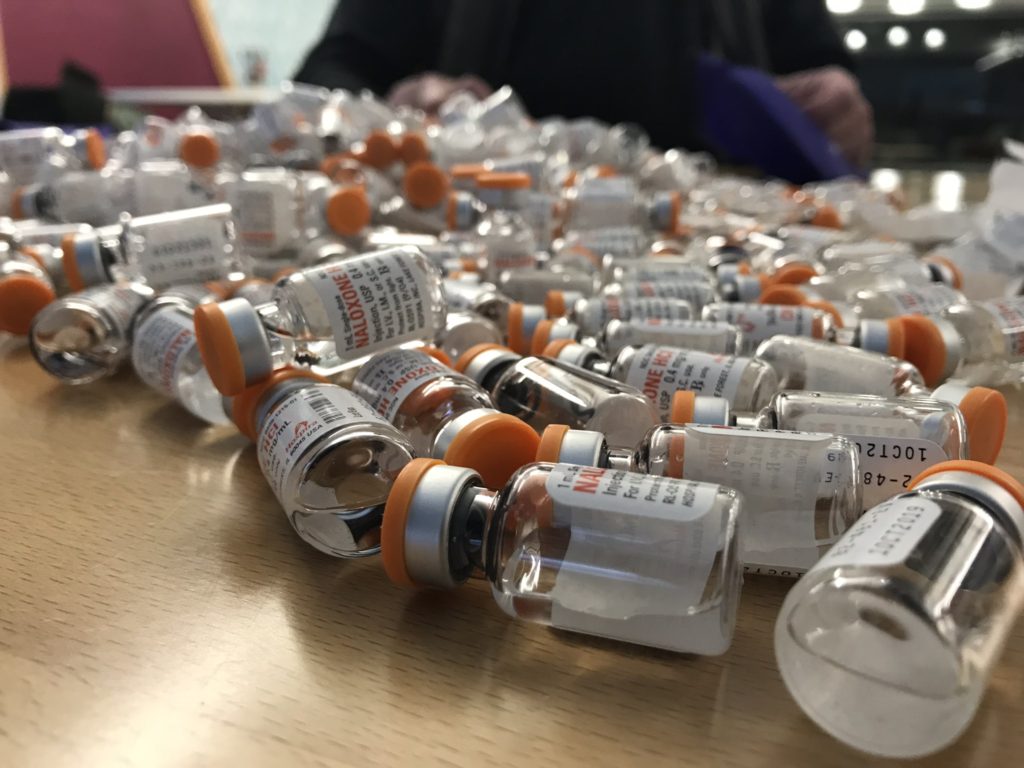
Vials of naloxone being packaged in overdose prevention rescue kits by the Steve Rummler HOPENetwork, member of the FED UP! Coalition and an organization which operates a community-based overdose prevention program in Minnesota.

However, the comments of the Committee members regarding their votes show that many of them saw co-prescribing as less important in the overall public health effort than assuring measures such as inexpensive over-the-counter availability of naloxone and assuring an adequate supply of naloxone to community-based distribution networks.

Comments taken from two of those who voted “Yes” to co-prescribing language demonstrate this:   

Dr. Daniel Ciccarone of UCSF said, “What we really need is to support our friends in the community who are  doing great work over multiple years, we need OTC switch, we need federal stockpiling, we need parity in the injection versus intranasal labeling; we need generics.”


“What we really need is to support our friends in the community who are  doing great work over multiple years, we need OTC switch, we need federal stockpiling, we need parity in the injection versus intranasal labeling; we need generics.”

Dr. Daniel Ciccarone of ucsf

Dr. Brian Bateman of Harvard said, “This is really not the most important issue with respect to naloxone. What’s emerged from the discussion is that we need a way of getting inexpensive naloxone to community based programs and finding a sustainable model for funding that and lowering all of the barriers that might impede that.”

It should also be noted that for a prescription medication to become an over-the-counter product, a manufacturer must submit a consumer-friendly drug facts label (DFL) and proper study which illustrates the medication is easily administered or taken without the assistance of a medical professional. The FDA has developed a model DFL and now waits for a manufacturer to submit an OTC naloxone product for review. This is the first time the FDA has proactively developed a model DFL. FDA representatives at the December meeting mentioned there has been great interest among manufacturer and once something is formally submitted it will be fast-tracked to become an OTC product. The concern still lies with insurers covering an OTC product, indicating an OTC framework is not a panacea to increasing accessibility of naloxone.

The FED UP! Coalition advocated for:

  • All forms of naloxone to be sold over the counter
  • The Federal government to subsidize over the counter naloxone to keep the price under $20 per dose.
  • The Federal government to launch a public awareness campaign regarding Naloxone to cover such issues as:
    • Should you have naloxone in your home or place of business?
    • How do you know when to administer naloxone?
    • How do you administer naloxone?

The day after the FDA Advisory Committee Meeting, HHS issued a Guidance called: “Naloxone: The Opioid Reversal Drug that Saves Live.”  Included it in are the following co-prescribing recommendations:

“In order to reduce the risk of overdose deaths, clinicians should strongly consider prescribing or coprescribing naloxone, and providing education about its use for the following patients who are at risk of opioid overdose: 

  • Patients prescribed opioids who:
    • Are receiving opioids at a dosage of 50 morphine milligram equivalents (MME) per day or greater;
    • Have respiratory conditions such as chronic obstructive pulmonary disease (COPD) or obstructive sleep apnea (regardless of opioid dose); 
    • Have been prescribed benzodiazepines (regardless of opioid dose). 
    • Have a non-opioid substance use disorder, report excessive alcohol use, or have a mental health disorder (regardless of opioid dose).
  • Patients at high risk for experiencing or responding to an opioid overdose, including individuals: 
    • Using heroin, illicit synthetic opioids or misusing prescription opioids. 
    • Using other illicit drugs such as stimulants, including methamphetamine and cocaine, which could potentially be contaminated with illicit synthetic opioids like fentanyl.
    • Receiving treatment for opioid use disorder, including medication-assisted treatment with methadone, buprenorphine, or naltrexone.
    • With a history of opioid misuse that were recently released from incarceration or other controlled settings where tolerance to opioids has been lost.”

A special thank you to those who’ve pioneered and progressed overdose prevention and harm reduction initiatives and increased naloxone accessibility in communities across America, including:

  • Eliza Wheeler and Sharon Stancliff
  • Lexi Reed Holtum and Randy Anderson
  • Alexander Walley
  • Phillip Coffin
  • Maya Doe-Simkins
  • Corey Davis
  • Traci Green
  • Dan Bigg
  • Jeffrey Bratberg
  • Chad Sabora
  • Robert Childs
  • Andrew McAuley
  • Daniel Raymond
  • Robert Riley
  • And the many others.

President Trump signs comprehensive opioid package into law

One year ago, President Trump declared the opioid crisis a public health emergency. On Wednesday, the opioid package was signed into law with $8.5 billion allocated for opioid solutions. This will provide critical funding to the states to combat the growing opioid crisis across America.

Key components of the bill include funding for addiction treatment, recovery housing and job training for people with substance use disorder and a lift on an outdated rule which barred Medicaid from covering addiction treatment in facilities with more than 16 beds. Expanding access to medication assisted treatment is another function of the bill, widening the scope of prescribing for non-physician prescribers.

With fentanyl now the leading cause of opioid overdoses in our country, measures to tighten postage tracking will also be implemented.

The bill allocates the money over the next year. Although the bill is an excellent step in the right direction and an example of bipartisan cooperation to address the crisis, until addiction is treated as a disease by society and truly confronted as a public health emergency, we will continue to see an influx of overdose deaths and the number of individuals suffering from the disease of addiction. Fighting systemic injustices is critical. Insurers upholding parity, coverage of addiction treatment, standards of care for recovery residences, compassion and care towards those who use opioids to manage pain, reducing addiction stigma; all are essential changes we need.

The funds are simply not enough. Hundreds of billions are needed over multiple years. A proposal by Sen. Warren and Sen. Cummings would have done just that. Modeled after the Ryan White CARE Act, legislation that funded solutions and support for communities impacted by HIV/AIDS, the Warren-Cummings proposal called for $100 billion over 10 years. This proposal was not included in the final opioid bill. With more attention to treatment for opioid use disorder, it’s important for us to also advocate for recovery services. Recovery for the individual and the family.

These funds would never have been made available without you. You called, emailed, showed up, and told your stories. We, as a coalition, work together as individuals and organizations to advocate for these changes, to save lives, to deliver compassion to our communities. Only together are we a powerful constituency, a unified message, a coalition. We have a lot of work ahead of us. Today, the Ensuring Patient Access and Drug Enforcement Act still stands, the FDA continues to approve new, highly potent opioids, and overdose deaths continue to soar.

We will continue to demand Federal action, to rally in cities across the country, and raise our voices. We’ll push forward in our local communities with the work of our organizations and the advocacy of the individuals demanding change.

Arsonist Awarded Patent for Fire Extinguisher! Shocking?  So is this recent news …..

Richard Sackler, the former Chairman and President of Purdue Pharma, and Rhodes Pharmaceutical (a subsidiary of Purdue Pharma) have been awarded a patent for treatment of opioid use disorder, the disorder the Sackler family and Purdue Pharma knowingly fueled along with overdose, death and family tragedy.

At a minimum the patent should serve the public good and provide no economic benefit to the Sackler Family.

The patent petition ignores Purdue Pharma’s role and responsibility for creating the need for the invention. The application for the patent (Patent no. 9861628) includes the following:

“Chronic pain, which may be due to idiopathic reasons, cancer or other diseases such as rheumatism and arthritis, is typically treated with strong opioids.

“Thus, if opioids are taken by healthy human subjects with a drug seeking behavior they may lead to psychological as well as physical dependence.”

“One of the fundamental problems of illicit drug use by drug addicts (“junkies”) who are dependent on the constant intake of illegal drugs such as heroin is the drug related criminal activities resorted to by such addicts in order to raise enough money to fund their addiction.”

Outrageous, dishonest and lacking any acknowledgement of responsibility for fueling the opioid epidemic thru deceptive marketing and promotion of Sackler products.

FDA approval of a product made through this patent and a company (Rhodes) set up to obscure the Sackler connection would allow the Sackler family to reap more profits from a treatment for the epidemic caused by Sackler family products.

We cannot allow this to happen. 

Sign up for our mailing list today and we’ll let you know how you can help as plans are formulated to make sure that the Sacklers never profit from this new patent.